Latest Articles
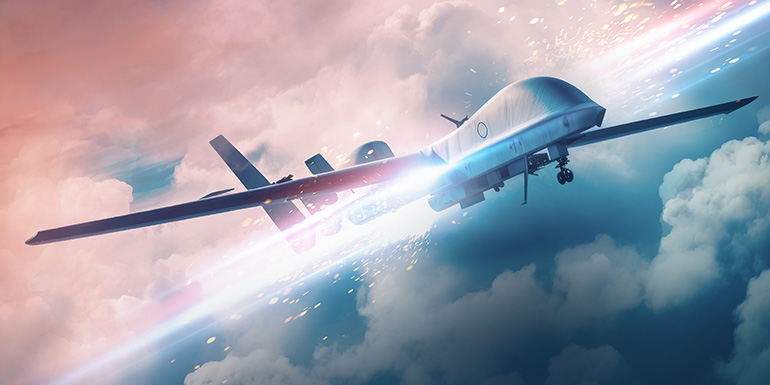
UASs in the Modern Electronic Battlefield
With dominance of the electromagnetic (EM) spectrum increasing in importance and U.S. military vehicles and systems being faced with an array of threats from various adversaries, control and management of the EM spectrum will determine where future battles are won or lost. Simultaneously, the use of unmanned aerial systems (UASs) in the battlefield for surveillance, targeting, and weapons delivery continues to rise.
Read More about UASs in the Modern Electronic BattlefieldUsing Machine Learning for a Dynamically Coupled Fluid-Structure Interface
A dynamically coupled interface has been developed to determine the three-dimensional transient thermo-structural response of the hypersonic vehicle during its flight. Dynamic coupling is required when the change in aerothermal state, surface temperature, ablation, mass/momentum/energy transfer at the surface, and shape change of a hypersonic vehicle due to the thermal loading from the aerothermal environment couples with the structural solver. This results in a strong coupling between the two codes.
Read More about Using Machine Learning for a Dynamically Coupled Fluid-Structure InterfaceMicrodiode Laser Primers – A Path Forward
The concept of using lasers to ignite propellant and energetic material is not new. At the U.S. Army Combat Capabilities Development Command-Armaments Center (DEVCOM-AC) at Picatinny Arsenal, NJ, the Army explored efforts to use external mounted lasers for medium- and large-caliber weapons systems, with modest success in the 1980s through 2010.
Read More about Microdiode Laser Primers – A Path ForwardPerception and Navigation Algorithms for Legged Robots
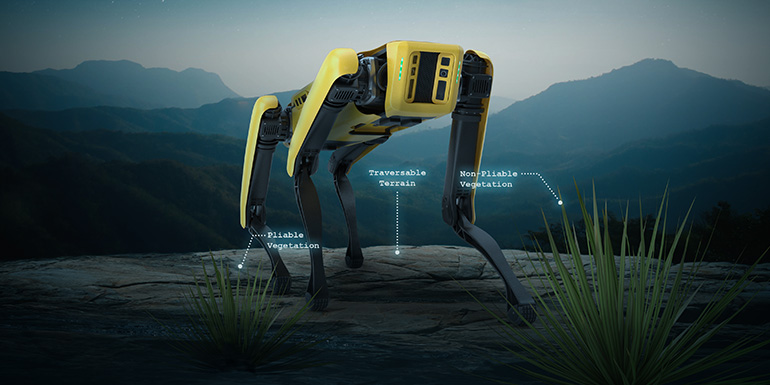
Mobile robots, equipped with wheels, tracks, or legs, are designed to move from a start location to a goal in various indoor and outdoor environments. A key area of interest is making them capable of autonomously navigating diverse environments.
Read More about Perception and Navigation Algorithms for Legged RobotsAnalysis of Powder, Bullet, and Barrel Interactions
All ammunition makers and reloaders “know” that changing propellant type can affect the group size (dispersion) of the ammunition they make. Why changing powders affects bullet group size is more than a matter of propellant burnout prior to muzzle exit or some other easily definable characteristic. This article details the investigations undertaken to better understand this phenomenon and why it occurs.
Read More about Analysis of Powder, Bullet, and Barrel InteractionsDesigning Primary Structures With Fiber-Reinforced PEEK Thermoplastic Composite
Introduction Polyetheretherketone (PEEK) is a semicrystalline thermoplastic that was invented in November 1978 and brought to market in 1981 by Imperial Chemical Industries, which later became Victrex. As developed, this material possessed a maximum 48% degree of crystallinity. The composite material was introduced a year later as APC-1 with a 52% fiber volume, and it […]
Read More about Designing Primary Structures With Fiber-Reinforced PEEK Thermoplastic CompositeUncertainty Quantification to Detect Resident Space Object Anomalies
Summary Anomaly detection, whereby signals are scanned for behavior changes, is a common problem in many applications. As data streams grow in complexity and volume, automated methods for anomaly detection, especially those based on machine learning (ML), are increasingly attractive. However, many real-world defense applications like space domain awareness (SDA) are challenging environments for these […]
Read More about Uncertainty Quantification to Detect Resident Space Object AnomaliesDetecting and Defending Against Malicious Attacks to Ship Sensors
Summary This article describes research to detect phenomena that may degrade or disrupt the performance of an otherwise fully functional sensor. Also examined are methods to potentially mitigate the effects of sensor degradation and develop effective countermeasures that enable naval vessels and unmanned vehicles to continue their missions with degraded capabilities. An emphasis is placed […]
Read More about Detecting and Defending Against Malicious Attacks to Ship SensorsA Bioinspired System to Autonomously Detect Tiny, Fast-Moving Objects in Infrared Imagery
Summary Autonomously detecting tiny, fast-moving objects emitting thermal radiation in the infrared is a challenging technical problem. In addition to being fast, these targets are often dim, small, and in the presence of clutter and occlusions. Conventional detection approaches require large size, weight, and power (SWaP) systems which may introduce substantial latencies. As such, the […]
Read More about A Bioinspired System to Autonomously Detect Tiny, Fast-Moving Objects in Infrared ImageryEmerging Risks in Space From China and Russia
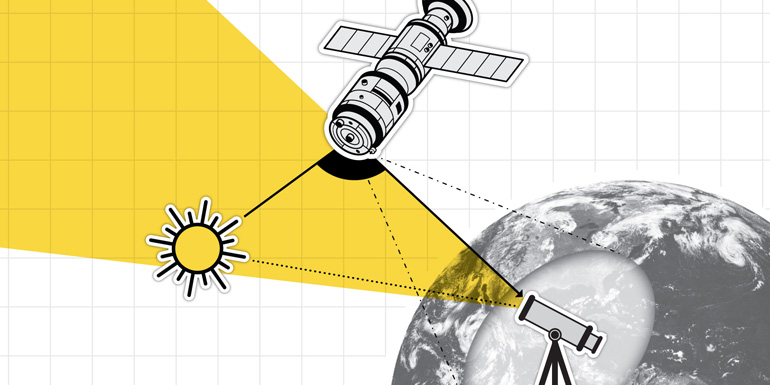
Summary Emerging technologies include not only novel technical inventions but also repurposing existing technologies into new tactics, techniques, and procedures. In recent years, Russia and China have upended the way the space domain has operated for decades. For example, China has repurposed the Cold War-era concept of a “fractional orbital bombardment system” to deploy a […]
Read More about Emerging Risks in Space From China and Russia